Planning a Week
11 February 2020
21:27
Remaining steps to fill ATP. Fill column weights and ability-focused columns of each sport.
Weights:
- Prep:
- AA (Anatomical Adaptation) = get your body used to exercises
- MT (Muscular Transition) = increase load while reducing repetitions
- Base1:
- MS (Maximal Strength)
- Base 2,3; Build 1,2; Peak:
- SM (Strength Maintenance)
- Race:
- If 1 week, no weights
- If > 1 week (e.g. You have 2 or 3 races in back to back weeks and therefore extend the race period), SM
- Transition:
- No weights
Swim / Bike / Run
- For each sport: column for each ability in each sport + column for testing (testing is usually done near the end of a rest and recovery week)
- Abilities by periods:
- Preparation:
Your focus should be only on becoming accustomed to the strength exercises and gradually moving to heavier loads for each exercise. The only sport-specific abilities to be included now are AeE and SS. Place an X on these two columns for each sport, for every week in your prep period. Also put an X in the Testing column for the last prep period week.
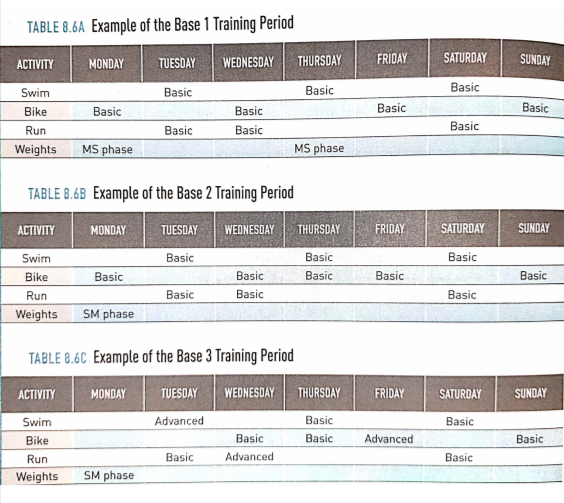
- Base 1:
The emphasis is on strength training, because you are now using heavier loads and low reps. These make for very challenging workouts 2 or 3 times a week, so the sport-specific workouts are quite easy. Put an X in the AeE and SS columns for each week in this period. Also put an X in Testing for the last week of this period
- Base 2:
Strength workouts will move from MS to SM, which will allow more time and energy for sport specific workouts. Put an X in MF and ME in addition to AeE and SS. MF can be omitted as long as you are still doing MS in strength, that may be the situation if your prep period was short. The MF workouts are the primary focus in this period, they are intended to take the force you acquired in strength workouts and convert it to sport specific power. ME workouts are only introduced and are therefore not long or difficult. In the last week, put an X for AeE, SS and Testing.
- Base 3:
In this period the training becomes more specific to the type of race for which you are training. Start by making the ability columns the same as Base 2. The major concern in this period are your race distance and your level of competition. If long course and highly competitive apply to you, then mark an X in the AnE columns for each week except the last week.
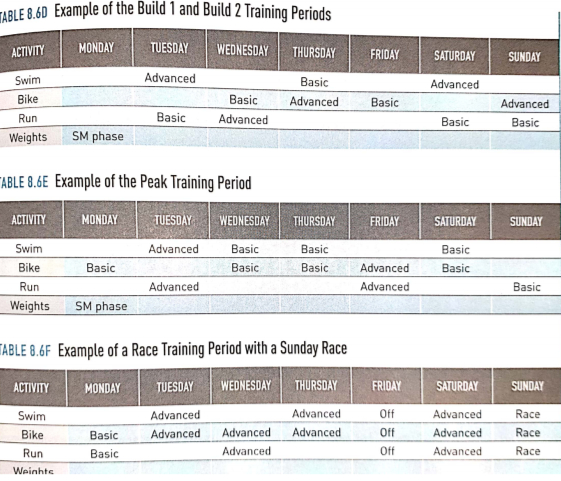
- Build 1 and 2:
At this point, your base fitness should be well developed. Put an X in all the abilities for all but the last week of each period. At this point, AeE, MF and SS become maintenance sessions and can be merged with the advanced sessions as part of the warm-up or even included in the recovery workouts. Multiple abilities are combined into a single session to make it more racelike. For olympic and sprint atheletes, the emphasis is placed on AnE. Put an X in AeE, SS and Testing for the last week of each period
- Peak:
In the peak period, emphasis on the expected intensity on the race is increase while workout duration is decreased. AeE and MF are eliminated from the training routine. SS can continue as a variation to recovery workouts. If you are racing a long distance, put an X in ME column only. If you are racing a short distance, put an X in AnE and ME columns. There is no testing in peak.
- Race:
The emphasis is set on recovery. Mark your race week as you did for peak.
- Transition:
Do not mark any abilities for this period. You can still exercise, but any training or exercise you do should be an unplanned, spur of the moment decisions and should be short and easy.
- Planning for later-season races:
Do an aerobic threshold workout to see how your efficiency factor compares with what it was back in your last base 3 period. If it is < 5% lower, then you can go straight to a build period. If it is > 5% lower, then you should go to base 3 training until your efficiency factory < 5% lower. The emphasis should be on AeE.
- At the end of a period, ensure your limiters in all 3 sports had ample time to develop. If one sport is not ready for advanced abilities, then keep basic abilities workouts in that sport in parallel with other sports doing advanced abilities workouts. If 2 sports are not ready to advance then its better to stay in that period a bit longer.
Weekly and daily training
- Continuity in training is beneficial both physically and mentally. Your body and your mind like it when the routine stays much the same week after week.
Personalized weekly routine
- On a sheet of paper or on your computer, write down the days of the week in a column
- Next you need to decide the days you will swim, bike, run and do strength workouts
- Anchor Workouts: Anchors are workouts that are tied to specific days and times and cannot be moved (lap swimming in pool with specific opening times, swimming the day the master swim trainer is there, group rides or group runs, …). Write these into your weekly plan first, and build all the other sessions around them. Be careful in group workouts not being caught in "racing" when your goal was skill or aerobic endurance
- Breakthrough Workouts (BT): Once you have noted the anchor workouts on your weekly routine, it's time to decide when to schedule the breakthrough sessions. These are the sessions that are stressful enough to produce greater fitness. All or a part of your anchor workouts can be breakthrough workouts. These key weekly workouts are either high intensity or long duration, for all sports and weights. You should schedule these workouts so that there is adequate time to recover before the next breakthrough workout (a day or so).
- Recovery Between Workouts: You must ensure there is adequate time to recover between key workouts. You must arrive at the breakthrough workouts rested and ready. More on recovery in next chapter
- Two-a-Days:
- A single workout each day with a day off from all training will give you a total of six sessions weekly, two in each sport. The 2 sport specific workouts should be separated by 2 days
- To increase number of workouts in a week, it is possible to make 2 a day.
- 2 a day raises the question of injury. Running on tired legs is very risky for some. If this is a concern to you, it's better to start with the running workout.
- It is also better to start with the breakthrough workout. Being tired in the breakthrough workout will nullify its value.
- 2 a day workouts can be "bricks", a combination of two or more workouts (bike-run, swim-bike, swim-bike-run). Such workouts can be performed year round, but they are the most beneficial during the build period, when breakthrough workouts become more race like. Typical bricks is a breakthrough workout in the first sport followed by a short recovery in the second sport (e.g. BT workout in cycling, immediately followed by a short run)
- Sports Distribution:
- A single workout each day with a day off from all training will give you a total of six sessions weekly, two in each sport. The 2 sport specific workouts should be separated by 2 days
- 9 workouts in the week gives 3 workouts in each sport, with a day or so between each sport specific workout
- If you can manager more than 9 workouts in a week, then it should either be cycling (biggest part of the race, hence biggest possible gains) or your limiters
- Finalizing your Weekly Routine:
- The table below gives an example of a base / build 9 workouts weekly schedule. The exact type of breakthrough workouts that you do depends on your strengths, limiters and the season period you are currently in.
Example of a Standard Training Week for Base and Build Periods (with 2 a day)
|
Monday |
Weights BT (BT in early base period only; otherwise SM) |
Rest and recovery |
|
Tuesday |
Swim BT (BT following early base only) |
Bike BT (BT following early base only |
|
Wednesday |
Run |
Bike (optional after early base period) |
|
Thursday |
Swim BT (BT following early base only) |
Weights BT (in early base period only; omitted in later periods) or Bike BT (included after early base period) |
|
Friday |
Run |
Rest and recovery |
|
Saturday |
Swim |
Run BT |
|
Sunday |
Bike BT |
Run (optional: done as a brick with a very short run or can be a race in build, but if B-priority then no BTs on Thursday or Saturday) |
Peak and Race Week Routines
Peak period routine
Peak period usually starts 3 weeks before your A priority race and lasts for 2 weeks (2 weeks before, 1 week duration also possible). The key is to mix intensity and rest, with emphasis on rest, to produce race readiness.
2 mistakes to avoid:
- Training too hard. Peak period should be a mix of rest and hard training with emphasis on rest. Trust that what you've done so far is enough.
- Resting too much. Rest produces greater form, but loses fitness. Some hard training are still required to maintain fitness
Peak week routine:
- Start 2 to 3 weeks before your A-priority race.
- Do a race intensity workout every third day that simulates the conditions of the race.
- The intensity should be similar to what you are expecting in the race, but at least zone 3 for HR, power or pace.
- Make this workouts gradually shorter as you progress through your peak period. With the workouts becoming shorter, your weekly volume is also dropping. That's good. It should drop around 30% to 50% each week.
- The other 2 recovery days should be low-intensity, low-duration and should also become shorter as the peak period progresses. Their goal is to reduce fatigue while elevating form.
- Example 2-week peak period routine in the table below
|
Monday |
Weights (SM) |
Rest and recovery |
|
Tuesday |
Swim BT |
Bike BT (can be a swim-bike brick) |
|
Wednesday |
Run |
|
|
Thursday |
Swim |
Bike |
|
Friday |
Bike BT |
Run BT (best done as a brick) |
|
Saturday |
Swim |
|
|
Sunday |
Bike |
Run (done as a brick to rehearse transition) |
|
Monday |
Swim BT |
Bike BT (can be a swim-bike brick) |
|
Tuesday |
Bike or day off from training or weights (SM) |
|
|
Wednesday |
Swim |
Run |
|
Thursday |
Bike BT |
Run BT (best done as a brick) |
|
Friday |
Swim |
|
|
Saturday |
Run |
|
|
Sunday |
Bike BT |
Run BT (best done as a brick) |
Race period routine
- In a race week, do 3 or 4 workouts in which you include several 90 seconds intervals with 3 minutes recoveries following a warm-up. Cool down afterwards.
- For short course race, the intensity is zone 4 to 5
- For long course race, the intensity is zone 3
- Do not use heart rate to gauge intensity as you heart does not have enough time to respond in such short intervals.
- Over the course of the week, you need to decrease the number of intervals.
- 2 days before the race should be the easiest day. This is usually a day off.
- The day before the race:
- It is a good idea to do your last swim workout in the same conditions as the race (same lake, same time) to know what things look like at that time of the day.
- After the swim, if it's very early, have a light breakfast and leave some time for digestion.
- Then you can follow with a bike-run brick. Do a 20min ride (including warm-up), followed by a 10min run (including cool-down jog).
- Do only one 90 seconds interval in each sport
|
|
Saturday Race |
Sunday Race |
|
Monday |
Swim or day off from training |
Swim or day off from training |
|
Tuesday |
Swim BT° (5) + bike BT (3) |
Swim BT° (5) + bike BT (3) |
|
Wednesday |
Brick: bike BT (4) + run BT (2) |
Brick: bike BT (4) + run BT (2) |
|
Thursday |
Day off from training or very easy and short bike ride; possible travel day |
Swim BT (3) + run BT (1) |
|
Friday |
Swim BT (1) + bike BT (1) + run BT (1) |
Day off from training or very easy and short bike ride; possible travel day |
|
Saturday |
Race |
Swim BT (1) + bike BT (1) + run BT (1) |
|
Sunday |
Day off from training |
Race |
° BT indicates a breakthrough workout. These are 90-second intervals with 3-minute recoveries done at race intensity, but at least zone 3 for pace or power. The non-breakthrough workouts are here for rest, recovery or skill maintenance and are done in zones 1 and 2. All breakthrough workouts gradually decrease the number of intervals as the week progresses. The suggested number of 90-second intervals per sport on each day is shown in parentheses.
Weekly volume distribution
- Based on volume form or TSS form determine your daily distribution
- Then divide your weekly volume into workout hours/TSS:
- Determine your expected time splits by sport in your next A priority race and use that to decide the percentage of time or TSS devoted to each sport (e.g. 10% swimming, 50% cycling, 40% running)
Planning your training week
- Subtract the anticipated time/TSS dedicated to weight lifting
- Divide the rest between the 3 sports, as described above.
- You can make adjustments to this distribution based on your limiters (move some time from your strongest sport to your weakest). Not more than 10%.
- Bricks are considered as a separate workouts for each of the sports involved.
- Write the anchor workouts (some anchor workouts can be BT as well)
- Write the BT workouts. Common for advanced triathlete to do one BT workout for each sports in a week. Too many is far worse than too few.
- The remaining time will be dedicated to recovery and speed skills sessions. They are usually low-intensity and low-volume workouts.
Example of weekly planning:
Workout Specifics
Workout Timing
In which order in the day, should you 2-a-day workouts:
- If one is a BT workout in your limiter sport, then this one should be done first.
- If both workouts are BT, running should be done before. Running on tired legs increases the chance of injuries.
In which order should you do your long workouts in the weekend:
- Often people think that since they will be tired in the run, they should do the bike Saturday and the run Sunday. But this is wrong. The fatigue you experience out of T2 is not the same. And running on tired legs increases the chance for injuries.
- If not possible otherwise, then run on Saturday and cycle on Sunday.
- The best solution is to do one long workout on Tuesday, Wednesday or Thursday (probably the run as it is shorter). That way, with the ride in the weekend, you will be fresh for both.
Brick Workouts
- You can do the brick workouts year-round, but it's best done in the build period, when your workouts are becoming increasingly racelike. In this regard, the brick is nearly the perfect race preparation session.
- During the build period, it can be beneficial to do frequent short runs after most bike rides, if not all of them.
- It takes only 15 - 20 minutes of running off the bike to reap the benefits of the brick workout.
- Keeping the ride brief improves the quality of the run and reduces the risk for injury. Keep the preceding ride session short, but intense with the inclusion of muscular endurance intervals.
Anaerobic Endurance Workouts
Advanced long course triathletes should consider doing anaerobic endurance workouts in all three sports in the base 3 period. The reason is that while anaerobic endurance is similar to what short course triathlete will experience in race and they will therefore get plenty of AnE sessions in the build period, it is dissimilar to what can be expected in long distance triathlon. The focus of the build period will be on muscular endurance instead
Missing Workouts
- 3 days or fewer:
- Return to training as if nothing happened
- Don't try to make up the missed workouts
- 4 to 6 days:
- If it was due to illness, treat it as if you missed more than a week (next bullet)
- Otherwise, consider the time you missed as a rest and recovery period and either
- Remove 1 week from the current period and if that's not enough to be synchronized with your A-race again, remove 1 week from the next period
- Remove 1 week from the peak period
- 1 or 2 weeks:
- Go back to the previous period (base 3 if you were in build 1, base 1 from base 2 or even prep if you were in base 1)
- Stay in this period for 3 - 4 weeks or until your heart rate and perceived exertion matches your power and pace as they did before you stopped working out.
- At some point, to be synchronized with your race, you will need to leave out 1 to 3 weeks (or even more. This could mean omitting base 2 or even the first week of peak. Make sure you complete the full base period.
- More than 2 weeks:
- Back up one period from where you left off
- You will have to leave off some time. The priority to remove is:
- First week of peak
- Build 2
- Build 1
- Make sure you complete the full base period